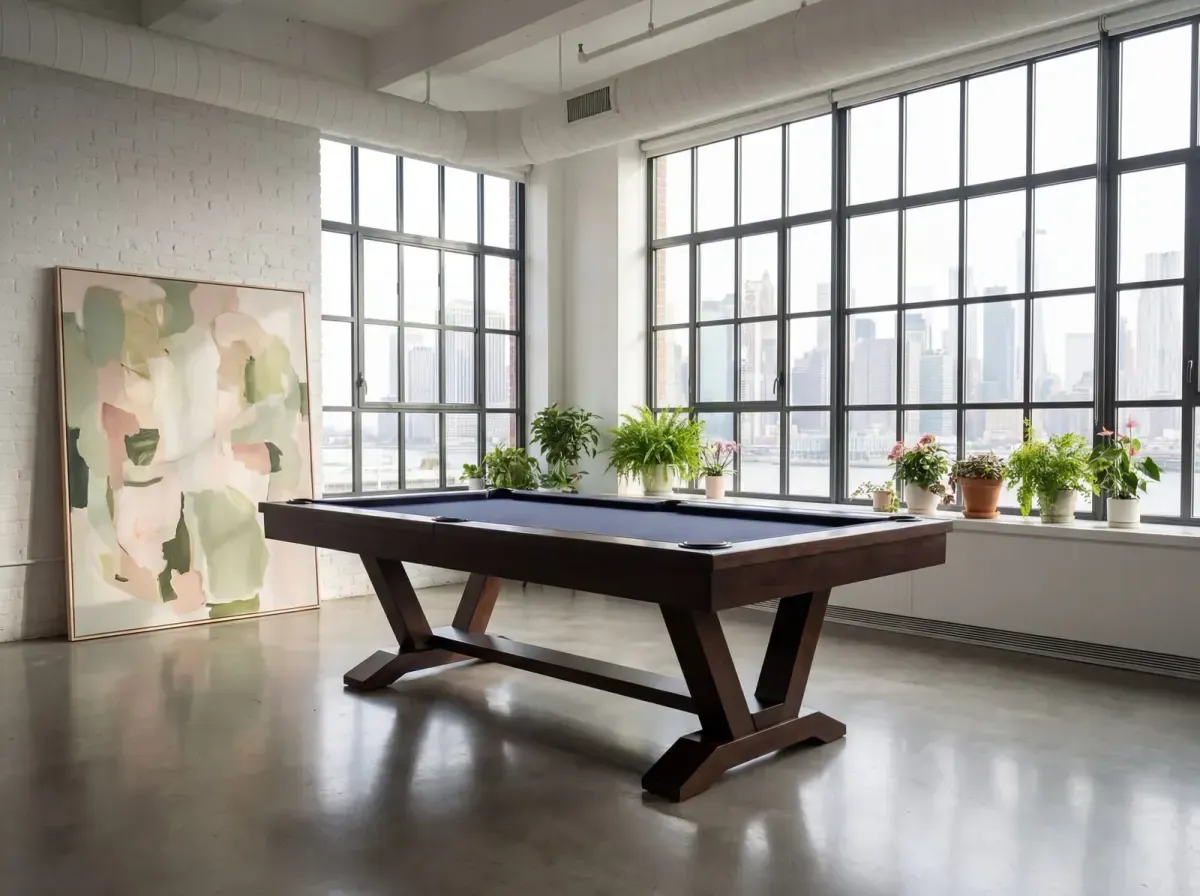
How to Choose the Right Pool Table Size for Your Room
I get this question about three times a week, and it's usually the same situation. Someone walks into the showroom at 1431 Leestown Rd with a measurement scrawled on a napkin, saying "I think it's about this big," and they're gesturing with their hands. Then I ask them to go home, actually measure the space, account for the cues, and come back. Half the time they discover they can't fit what they wanted.
The reason this matters is simple. A pool table is not like a couch you can squeeze in. You need real, usable space around all four sides to shoot. Not a foot of space. Not two feet. I'm talking about enough room to stand back and draw a cue fully, then follow through the shot without your cue hitting a wall.
The Basic Math
Most people don't realize that the cue itself is part of the equation. A standard cue is 58 inches long, though some players use 57-inch or even 60-inch cues. If you're a serious player, factor in the full 60 inches plus the distance from the table edge to where you'll stand. That's roughly 5 feet of clearance you need on every side at minimum.
Here's the room you actually need:
| Table Size | Playing Surface | Minimum Room Size | Recommended Room Size |
|---|---|---|---|
| 7-foot | 3.5 x 7 feet | 12 x 16 feet | 13 x 17 feet |
| 8-foot | 4 x 8 feet | 13 x 17 feet | 14 x 18 feet |
| 9-foot | 4.5 x 9 feet | 14 x 18 feet | 15 x 19 feet |
I've been selling pool tables for 50 years, and I can tell you that nine out of ten people who come in thinking they want a 9-footer actually need an 8-footer once we talk about their space. There's no shame in that. An 8-foot C.L. Bailey or Olhausen plays beautifully and lets you have a room that doesn't feel like a pool hall basement.
How to Measure Right
Don't eyeball it. Get a measuring tape and do this properly.
- Measure from wall to wall in both directions
- Identify where the table will actually sit (usually centered)
- Measure from the table's planned position to each wall
- Remember: you need at least 5 feet of clearance on every side for a standard 58-inch cue
Also think about the head of the table and the foot. You need enough room to set up and rack the balls. More realistically, you want 5 to 6 feet of usable space on at least one end so you can break properly.
Here's a practical tip I give almost everyone: sketch the room to scale on a piece of paper, draw in the table dimensions, and sketch in a cue. This takes five minutes and saves you from making a very expensive mistake.
The Question Nobody Asks: Ceiling Height
If your ceiling is lower than 8 feet, you've got a problem. Some people have those popcorn ceilings or drop ceilings in basements that sit at 7.5 feet or lower. A cue raised at a steep angle will hit the ceiling. You can use a special short cue, but that changes the game entirely.
If your ceiling is between 8 and 9 feet, you're okay for standard play, but shooting at certain angles on a high table gets awkward. This is another reason why the 8-footer is so popular for home use. It's forgiving about both horizontal and vertical space constraints.
What About Shorter Cues?
Some people ask about using shorter cues to fit a table in a tight room. Yes, you can buy a 52-inch cue. But here's what I've seen over 50 years: they don't feel right to most players, and they throw off your game. If you're serious about the table, you'll regret the compact space every time you shoot. If you're casual, consider a smaller table instead.
A break cue is sometimes shorter and always heavier, but that's a specialty tool for one shot. It doesn't solve your space problem.
When to Go Smaller, When to Go Bigger
If you've got 14 by 18 feet, an 8-footer is the right call. This is the most popular size I sell, and for good reason. It plays great, it fits normal homes, and the resale value is solid.
If you've got a finished basement that's 16 by 22, and you're genuinely planning to be a regular player, a 9-footer is worth it. The bigger playing surface changes the game. Shots play differently, position play matters more, and serious players notice the difference.
If your space is anything less than 13 by 16 feet, go with a 7-footer. Or don't put a pool table in that space at all. A table that's cramped and uncomfortable gets ignored, and then you've made an expensive mistake.
Come See the Tables in Person
This is why I always tell people to come down to the showroom at 1431 Leestown Rd before you decide. We've got demo tables in different sizes, and you can walk around them, hold a cue, and get a real feel for what 7, 8, or 9 feet actually looks like. Don't trust your imagination. A photo online doesn't show you what the space feels like when you're standing next to it.
Bring your measurements, and we'll talk through your space honestly. Every table we sell comes with free delivery and professional installation within 50 miles of Lexington, your choice of 29 cloth colors, and a complete accessory kit.
If you've got questions about your space before you come in, give us a call at (859) 255-7639. We're open Monday through Saturday, 10am to 6pm. I'd rather spend ten minutes on the phone than have you buy the wrong size.
Greg Wilson
Owner of Lexington Billiards & Spas since 1975. Greg has spent 50+ years selling, delivering, and servicing pool tables, hot tubs, and game room furniture in Central Kentucky. Read our story
More on Pool Tables

In Business Since 1975 · Lexington, KY
Ready to Make Your Home Legendary?
(859) 255-7639Mon-Sat 10am-6pm | Sunday Closed
1431 Leestown Rd, Lexington, KY 40511